Australia's Building and Construction Industry: Where the Opportunities Are
Estimating, contract administration, supervision and management: the roles construction is hiring for, the shifts changing what employers ask for, and how to position yourself for them.
Building and construction shapes the country's infrastructure and its cities, and it keeps changing. New methods, new technology and persistent skill shortages are all reshaping how the industry hires and what it pays for. Here is a look at the career opportunities, the trends driving them, and how qualifications fit into the picture.
More Than One Way In
Trade qualifications have traditionally been the main route into construction, and they remain an excellent one. They are no longer the only one.
Plenty of people enter through office based and technical roles instead, bringing analytical and organisational skills rather than time on the tools. Estimating and contract administration are the clearest examples, and both sit close to the commercial heart of a project. If you can read a drawing set, work accurately with numbers and manage documents without losing track, there is a path here that does not require an apprenticeship.
For people already in the industry, further study is how you move up. Project management, building and construction management, specialised trades and design all offer room to grow, and formal qualifications are frequently what separates two candidates with similar site experience.
Roles Across the Industry
- Labourers and apprentices. Labourers support tradespeople and learn the rhythm of a site from the ground up. Apprenticeships remain the standard entry point for carpenters, electricians, plumbers and other licensed trades, and they combine paid work with formal training.
- Design professionals. Architects and designers set the aesthetic and functional direction of a project, working with engineers and clients to produce buildable, efficient designs.
- Estimators. Estimators price the work. That means quantity take offs, current supplier rates, labour and plant allowances, and the judgement to see what a drawing set leaves out. Accuracy here decides whether a job is profitable before anyone lifts a tool.
- Contract administrators. They keep projects within budget and compliant, managing contracts, variations, requests for information, progress claims and the communication between parties. A strong grasp of security of payment time frames matters enormously in this role.
- Project managers. They own delivery, covering program, cost, quality and stakeholders from start to handover. Leadership, organisation and clear communication carry as much weight as technical knowledge.
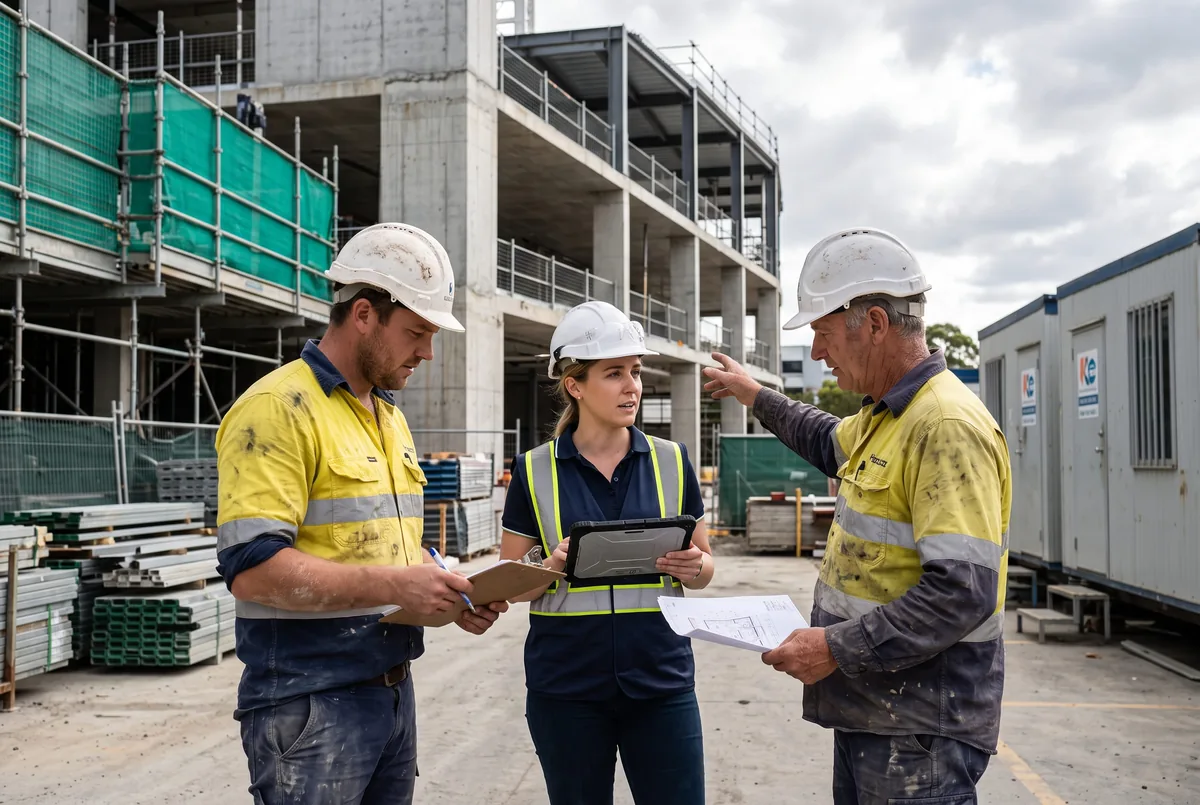
- Site supervisors. Supervisors run the day to day, coordinating trades and deliveries, enforcing safety requirements and keeping the program moving. They are the link between the plan and what actually happens on the ground.
What Is Driving Change
Several shifts are changing the skills employers ask for.
Prefabrication and modular construction move more work into controlled factory environments, which changes scheduling, logistics and the tolerances trades work to. Building information modelling is now standard on larger projects, so digital literacy and the ability to work from a coordinated model are increasingly expected rather than optional.
Sustainability requirements continue to tighten through the energy efficiency provisions of the National Construction Code, alongside growing demand for electrification, better thermal performance and lower waste. Safety expectations have also broadened, with psychosocial hazards such as fatigue, bullying and unreasonable workloads now recognised duties rather than side issues.
Salary Growth
Pay in construction tends to reward scarcity and responsibility. Skilled people in managerial and specialised roles generally see the strongest growth over a career, because both supervision and hard to find technical skills are difficult to replace.
Several factors move the number. Commercial and civil work usually pays above comparable residential work, regional and remote projects often carry allowances, and taking on supervision, licensing or commercial responsibility lifts you into a different band. Competitive packages have become more common as demand for capable people has risen.
Projected Job Growth
The outlook remains positive. Ongoing investment in infrastructure and housing keeps demand strong across a wide range of construction roles, and the Australian Government's Jobs and Skills Australia employment projections forecast national employment in construction to increase by around 12 percent over the decade to May 2035.
Projections are revised periodically, so treat the figure as a direction rather than a promise. The underlying point holds either way. This is not an industry facing a shortage of work.
How to Position Yourself
- Decide which pathway you actually want, since a trade, a technical role and a management track ask for different things from the start
- Get your White Card early, because it is the legal entry point for site work
- Keep a documented record of the projects you work on, including dates, values and your role, which supports both licensing and future qualifications
- Add a qualification deliberately rather than collecting certificates, and check what employers in your target sector actually list
- If you already have years of experience, Skills Recognition can convert that into a formal qualification without repeating what you know
- Build the communication and commercial skills alongside the technical ones, because they are what move you from doing the work to running it
A Solid Future
Construction offers real opportunity to people from a wide range of backgrounds. Sustainable practice and digital tools are reshaping how the work gets done, skill shortages mean newcomers and career changers are genuinely welcome, and the pathways in are broader than they have ever been. If you are weighing it up, the conditions are good.
Want to Go Further?
Techskill Academy (RTO 45055) delivers nationally recognised building and construction qualifications 100 percent online, built to fit around work. Visit techskill.com.au to explore the courses available in this field.
Source: Jobs and Skills Australia employment projections, jobsandskills.gov.au/data/labour-market-insights.
Ready to upskill?
Map a pathway that fits where you want to go next.